
House, open house, to the white dew
Helen Angell from our Sheffield chapter has used the lock down to read the work of Canadian-American poet and writer Elizabeth Bishop, who was the long-term romantic partner of Lota de Macedo Soares. In this article (and accompanying poems) Helen explores the award-winning house in Brazil that Soares designed, and more…
Although first invited to Brazil by Lota de Macedo Soares in 1942, it would be a decade before poet and writer Elizabeth Bishop turned a temporary visit into one that would last fifteen years. They become lovers after Soares nursed Bishop back to health following a violent allergic reaction. Wealthy and aristocratic, Soares offered to build her a studio in the mountains above Petropolis on land she already owned. In a letter of 1952, Bishop writes that Soares ‘is in the middle of building herself a large and elegant modern house on the side of a black granite cliff beside a waterfall – the scenery is unbelievably impractical’, a description evocative of the work of Frank Lloyd Wright.
Two years later the house won first prize in an architecture competition judged by Walter Gropius, a gift that turned their private home into something far more public, ‘Since the house got the prize we’ve had quite a few visitors to see it.’ Bishop captures the absurdity and falsity in the media’s creation of a modern lifestyle in her description of a photographer and models arriving for a Reader’s Digest covershoot, ‘a very heavy American boy – and three little girls dressed to kill and badly made up…Apparently the idea was that Lota and I shd. conceal ourselves while the three sad models posed in the house…It reminded me of my stay in Hemingway’s house where I had to chase tourists out of the front yard all the time.’
During her time in Brazil, Bishop also edited and translated Henrique Mindlin’s Modern Architecture in Brazil (1956) and visited Brasilia, the new capital of the country, with Aldous Huxley. Her reminiscences of the capital, then in the early days of construction, are documented in A New Capital, Huxley and Indians (1958). Having built a house for President Kubitschek in Bela Horizonte, Oscar Niemeyer was commissioned to build the public buildings in Brasilia. On Bishop’s initial encounter with The Palace of the Dawn, she writes in admiration of its’ lightness and grace’. Of the pillars she says, ‘it is no mean feat to invent a new ‘order’…a chain of huge white kites, poised upside down, then grasped by giant hands and squeezed in on the four sides until they are elegantly attenuated.’
Bishop’s third full collection, Questions of Travel (1965), was dedicated to Soares. Of note are the poems Electrical Stormand Song for the Rainy Season, both capturing Samambaia’s dramatic juxtaposition of nature and modern architecture.
In the same year the architect completed Flamengo Park in Rio de Janeiro. Modernist in design, this public reclamation project was a major undertaking, one that many felt contributed to Soares’ breakdown and eventual suicide in 1967. Their lives were portrayed in the 2013 film Reaching for the Moon.
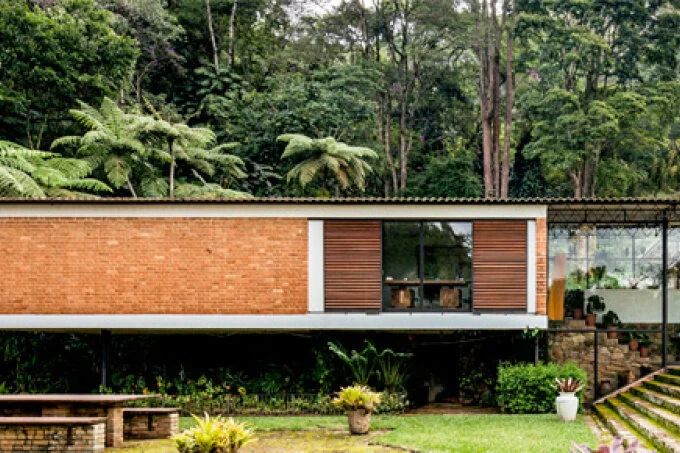
The house designed by Lota de Macedo Soares - Image: Casa Abril
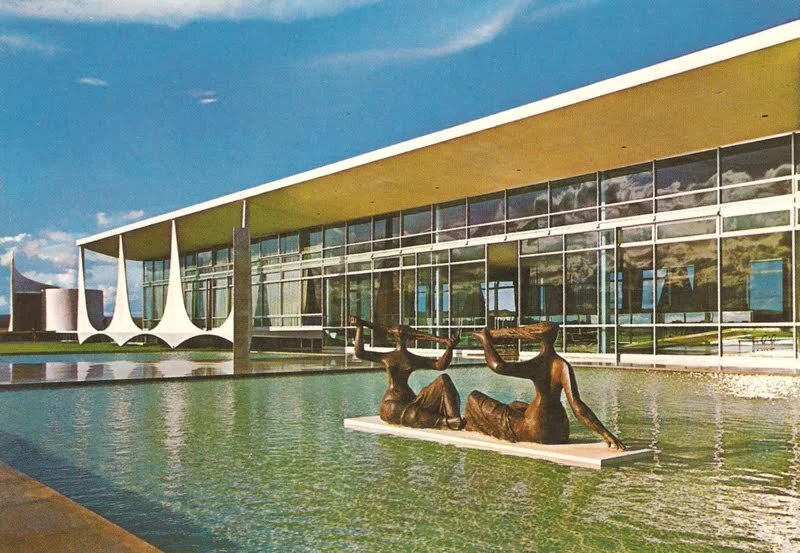
The Palace of the Dawn - Image: Didactic Discourse

Flamengo Park, Rio - Image: Tripadvisor
Electrical Storm
Dawn an unsympathetic yellow.
Cra-aack! — dry and light.
The house was really struck.
Crack! A tinny sound, like a dropped tumbler.
Tobias jumped in the window, got in bed —
silent, his eyes bleached white, his fur on end.
Personal and spiteful as a neighbor’s child,
thunder began to bang and bump the roof.
One pink flash;
then hail, the biggest size of artificial pearls.
Dead-white, wax-white, cold —
diplomats’ wives favors
from an old moon party —
they lay in melting windrows
on the red ground until well after sunrise.
We got up to find the wiring fused,
no lights, a smell of saltpetre,
and the telephone dead.
The cat stayed in the warm sheets,
The Lent trees had shed all their petals:
wet, stuck, purple, among the dead-eye pearls.
(Bishop: Poems, Prose and Letters - Library of America, 2008)
Song for the Rainy Season
Hidden, oh hidden
in the high fog
the house we live in,
beneath the magnetic rock,
rain-, rainbow-ridden,
where blood-black
bromelias, lichens,
owls, and the lint
of the waterfalls cling,
familiar, unbidden.
In a dim age
of water
the brook sings loud
from a rib cage
of giant fern; vapor
climbs up the thick growth
effortlessly, turns back,
holding them both,
house and rock,
in a private cloud.
At night, on the roof,
blind drops crawl
and the ordinary brown
owl gives us proof
he can count:
five times--always five--
he stamps and takes off
after the fat frogs that,
shrilling for love,
clamber and mount.
House, open house
to the white dew
and the milk-white sunrise
kind to the eyes,
to membership
of silver fish, mouse,
bookworms,
big moths; with a wall
for the mildew's
ignorant map;
darkened and tarnished
by the warm touch
of the warm breath,
maculate, cherished;
rejoice! For a later
era will differ.
(O difference that kills
or intimidates, much
of all our small shadowy
life!) Without water
the great rock will stare
unmagnetized, bare,
no longer wearing
rainbows or rain,
the forgiving air
and the high fog gone;
the owls will move on
and the several
waterfalls shrivel
in the steady sun.
(Reaching for the Moon -2013)