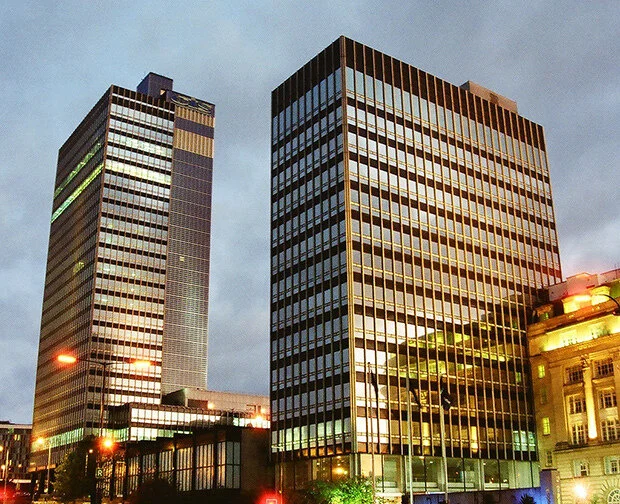
What is Mainstream Modern?
Our archival throwback today sees Modernist advisor and good friend Dr. Richard Brook introducing his project Mainstream Modern in February 2015. The website is a fantastic resource, and well worth checking out:
Mainstream Modern is a resource, an archive and a live project.
This website began life in 1998 when I began taking photographs with the aim of making an architectural guide to concrete in and around Manchester. The act of visiting a building and taking photographs is subject to many uncertainties, not least of all in the north-west of England – the rain. Like all good schemes, this one had no plan, no limits and no real deliverable objective until I was given two really good pieces of advice. One, to join the Twentieth Century Society and the other, to apply for a RIBA Trust Award to help define and complete my study.
Between 2007 and 2010 I worked to write a history of the architecture and planning of the post-war period in Manchester and to record and write guidebook type commentary on ninety-five selected buildings within the former county boundary of Greater Manchester. Only twenty copies were ever printed; most are with friends and family, though one copy is held by the RIBA Library in London. It’s not a book as such – the prose and syntax leave a lot to be desired – but it was the foundation and departure point for lots of new research. Thus, the first ninety-five buildings on this site are from that study, but I have travelled across the UK taking pictures and will slowly add new descriptions and images as I have the time to research, write and edit. I am working my way slowly around the North and further afield when time allows. As I find additional material about existing content I’ll add images and develop the texts.
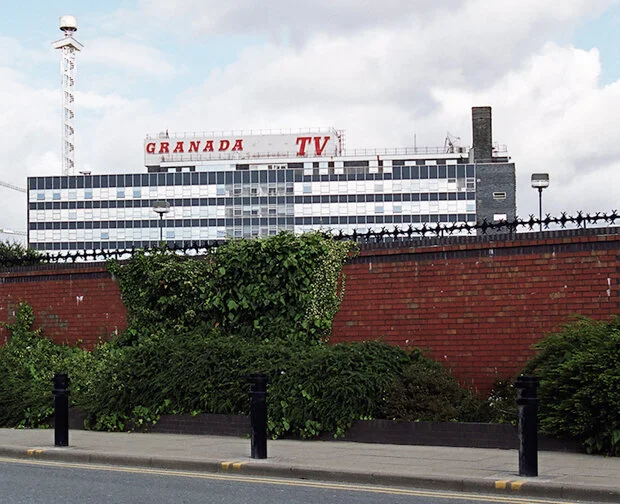
In terms of how to define the content of Mainstream Modern and criteria for inclusion, there are no strict rules, other than I have to have some form of fascination for a building, masterplan, artwork or unbuilt architectural project that features. Not only is it highly subjective, but is also an abuse of a term employed by Reyner Banham. It is used here as an umbrella that covers all of the above listed artefacts that are modern (usually after 1910), and not necessarily (though sometimes) of the avant-garde. There is a particular focus on post-war architecture and more predominantly the period 1960-73. This is in part due to the geographical area of the study, centred on Manchester, but expanding across the North, Midlands and Scotland to date. Manchester was a renewal city, not a recovery city.
Controls over building and resources were not lifted until 1954 and Manchester, like other post-industrial cities, did not see significant reconstruction until the 1960s. The oil crisis and financial collapse of the early 1970s curtailed further development and coincided with local government reforms that affected several metropolitan areas in 1974. This is relevant to another feature of content that will be prominent ? the local authority architect. Many departments under the guidance of County or City Architects had their heyday in the 1960s and into the 1970s, Lancashire included. As well as architecture of the welfare state I like industrial and functional buildings, system buildings and concrete. I enjoy the work of Gillepsie Kidd Coia, Lyons Israel and Ellis, Powell and Moya, Ryder and Yates, Chamberlin Powell and Bonn, John Madin, Peter Womersley and a host of less renowned regional practices and offices that I aim to present through Mainstream Modern.
I have used many resources and archives in my studies. Invaluable is the RIBA online search facility, a great engine and a comprehensive catalogue professionally administered. The journal collections of All Saints, John Rylands and Joule Libraries in Manchester have been, and remain, important to my work. As are the local studies collection and archives of the city and county, the MMU Visual Resource Centre and Special Collections. Many individuals have been kind with their time, advice, support, expertise and knowledge and I have tried to recall every person in the list of acknowledgments on the site. The most important person in this endeavour is Nina, her unwavering understanding of my peculiar hobby and its value to my work, the evenings and weekends when I have vanished or sat silently editing images.
Words and pictures by Richard Brook, Principal Lecturer at the Manchester School of Architecture.
Richard has made regular contributions to our magazine, The Modernist, and has led a number of our walking tours since the inception of the Manchester Modernist Society.