
Beverly Loraine Green & Stuy Town, New York
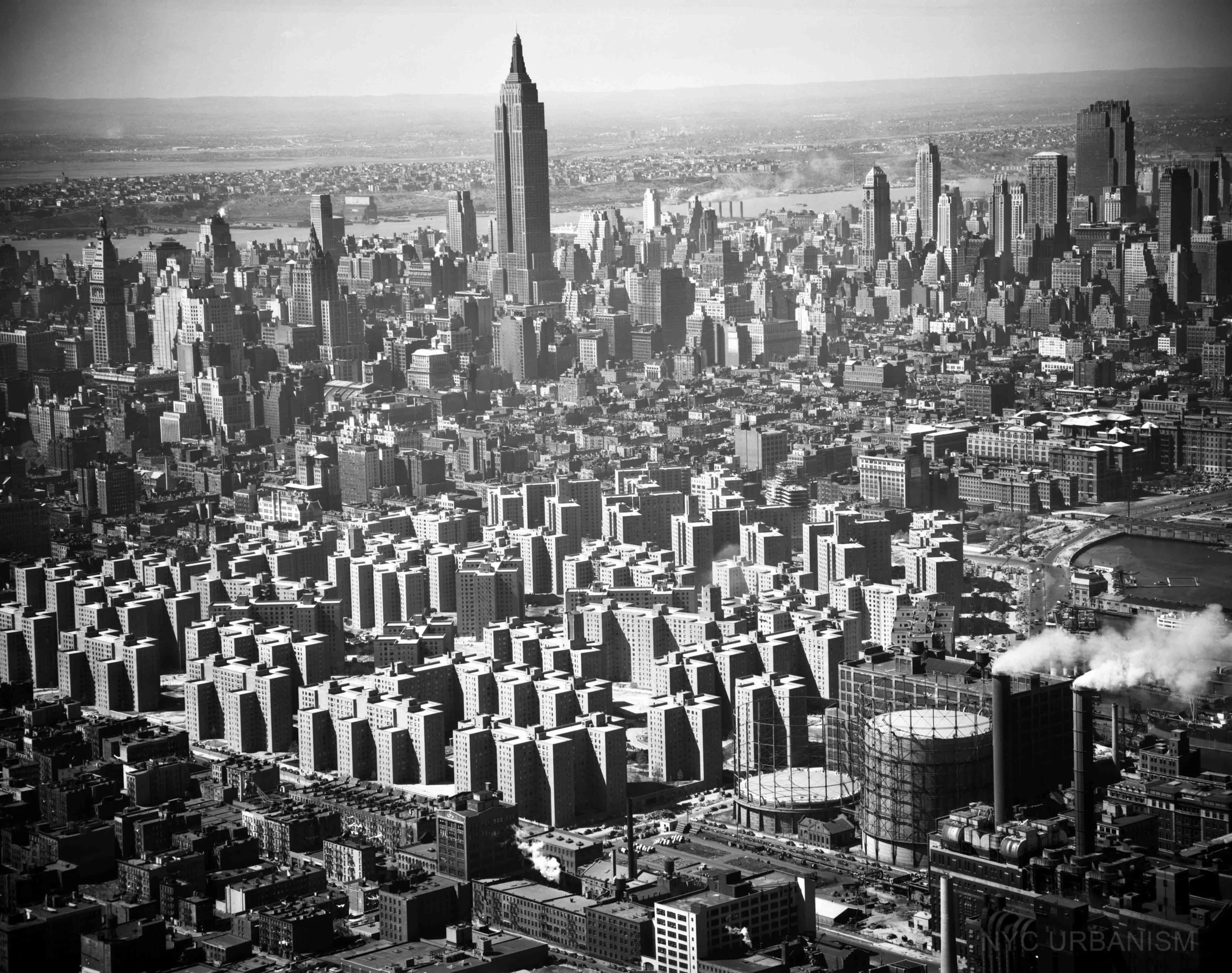
Stuyvesant Town, New York, NY
There are two interweaving stories that make up this post; the story of Beverly Loraine Green, reportedly the first African-American woman to receive a license to practice architecture in the USA, and the story of Stuyvesant Town-Peter Cooper Village (Stuy Town) in Lower East Side Manhattan, NY. While Greene only briefly worked on the Stuy Town development in 1945, both tell important, interlinked stories of the racial injustice faced by African-Americans in the US.
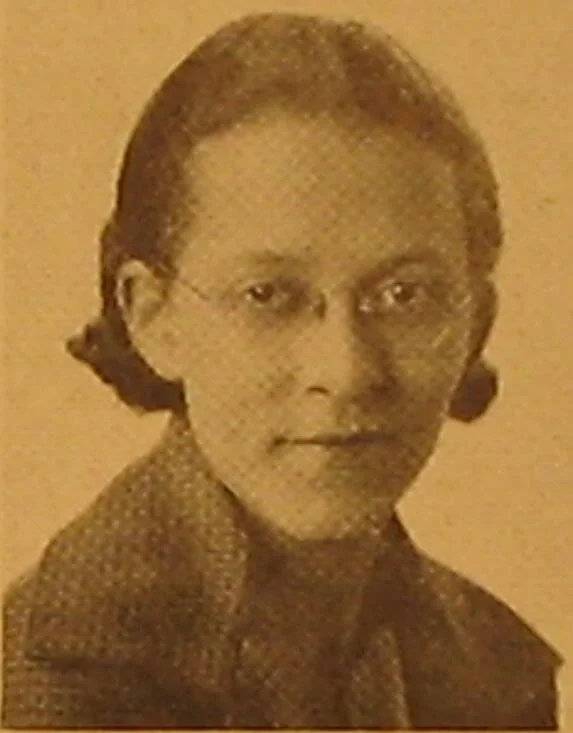
Beverly Loraine Greene as a student at University of Illinois at Urbana–Champaign
Beverly Loraine Greene was born 4 October 1915 in Chicago Illinois, an only child to parents James, a lawyer, and Vera, a homemaker. She went on to study at the University of Illinois at Urbana–Champaign, becoming the first African-American woman to receive a Bachelor of Science degree in architectural engineering in 1936, before going on to complete a Master of Science degree in city planning and housing. Greene was then hired by the Chicago Housing Authority, breaking race and gender barriers in the process, and received her license to practice architecture from the State of Illinois on 28 December 1942 aged just 27. Indeed, Beverly Loraine Green is reported to have been the first African-American woman to do so in the USA.
Despite her education and credentials, Greene struggled to secure work as an architect in Chicago due to racial prejudice, finding that she and her fellow black colleagues were frequently shunned by architectural firms and written out of the local press almost entirely. This resulted in a move to New York in 1945, where Greene applied for a role on the Metropolitan Life Insurance Company’s new development of Stuyvesant Town–Peter Cooper Village (often referred to as Stuy Town), a large-scale post-war housing project situated on a 72 acre site on the Lower East Side of Manhattan, NY.
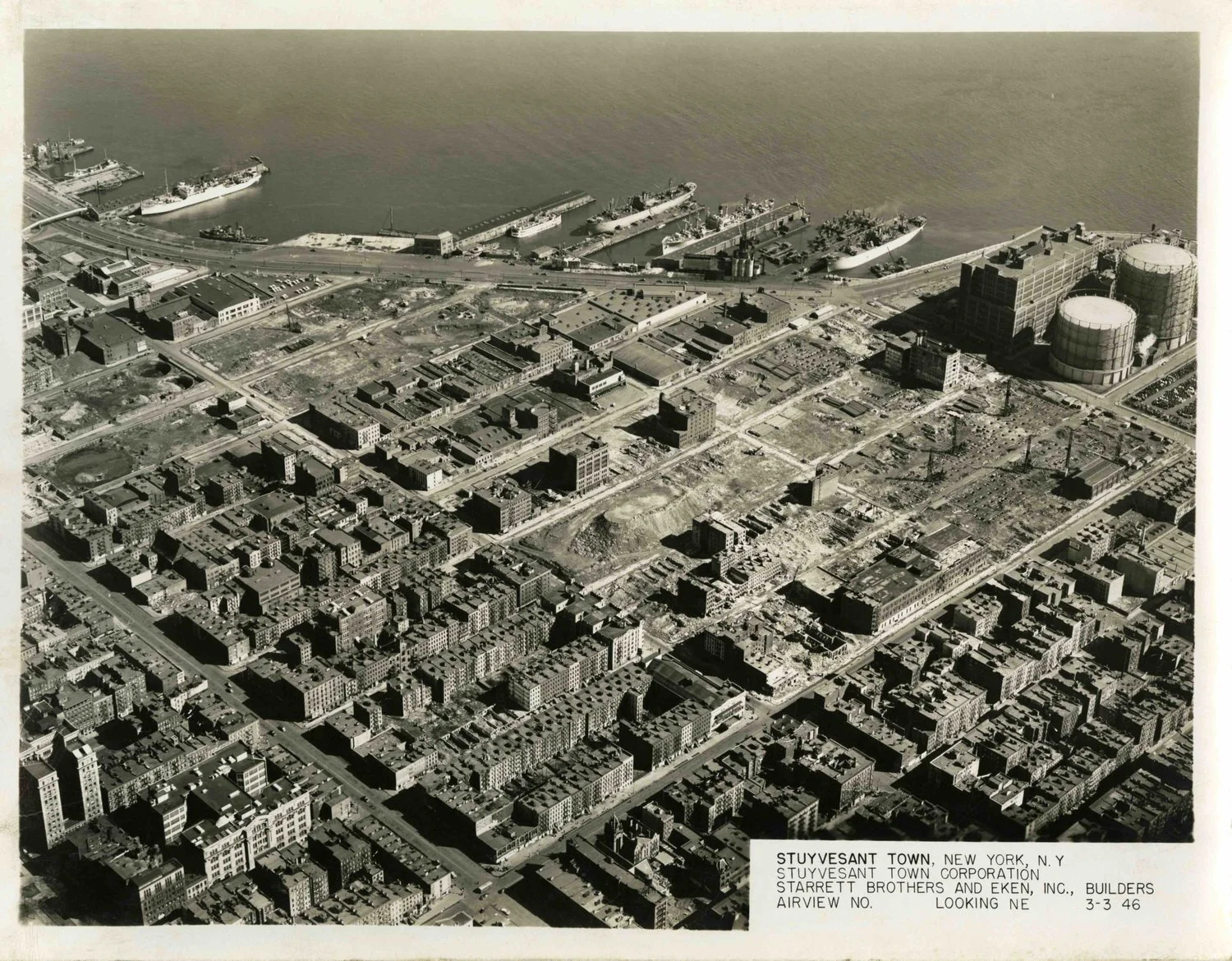
The former Gas House District, NY
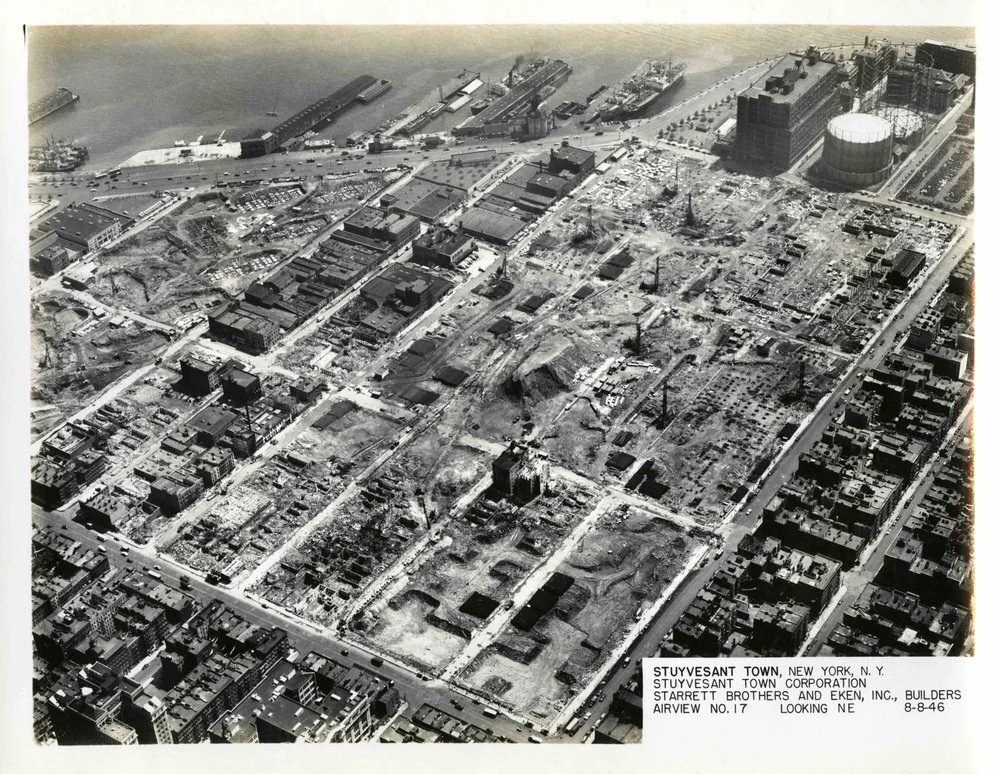
Demolition begins on the Gas House District, NY
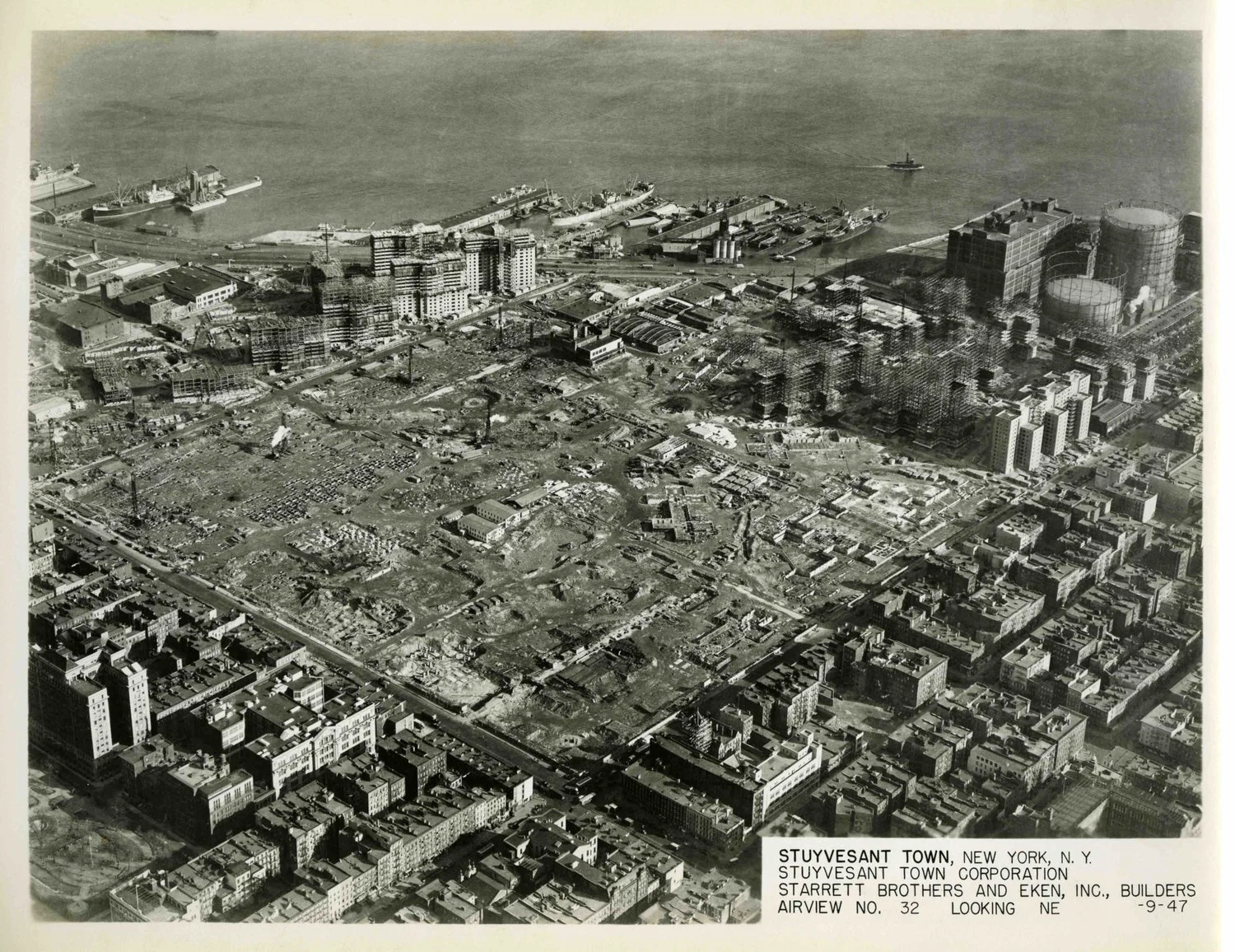
The cleared Gas House District site, ready for construction to begin on Stuy Town (see header photo)
Built on the former ‘blighted’ Gas House District, which had been demolished under the city’s slum-clearance scheme, the development was devised by Metropolitan Life which, at the time, insured one third of New York City’s population. The premise was that better living conditions would improve the company’s mortality numbers, thus increasing revenue for the company. Inspired by architect Le Corbusier’s use of green space, Stuy Town’s 110 buildings were designed to cover only a quarter of the site, dedicating the remaining three quarters to lawns, pathways, and playgrounds. In addition to reduced land coverage, the development housed only 302 people per acre, a drastic decrease in density compared with 1,100 people per acre across the site’s previous tenements at the beginning of the 20th century.
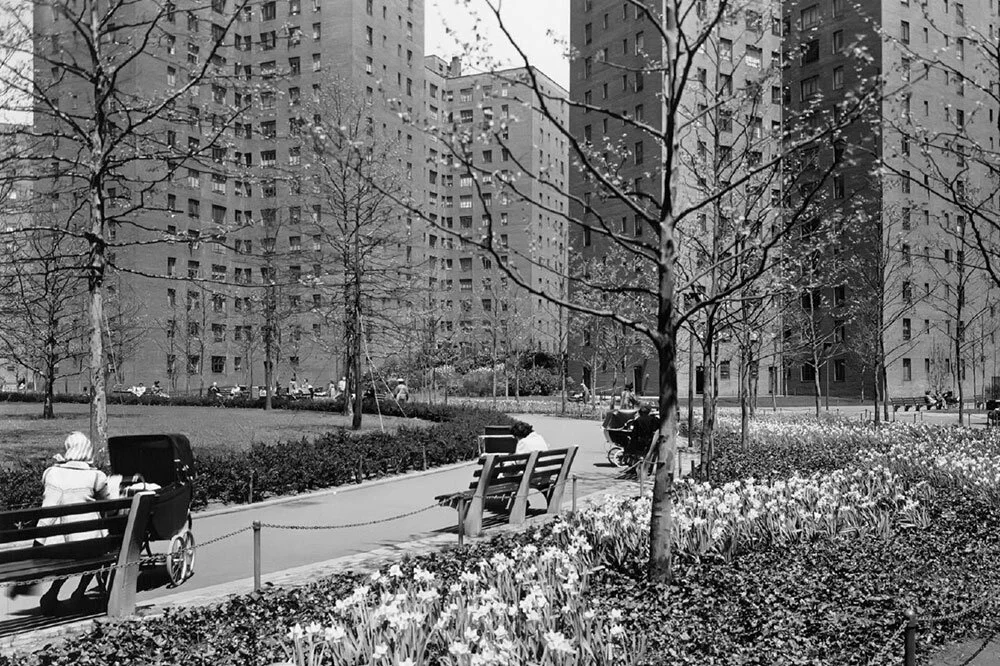
Stuyvesant Town in the 1960s
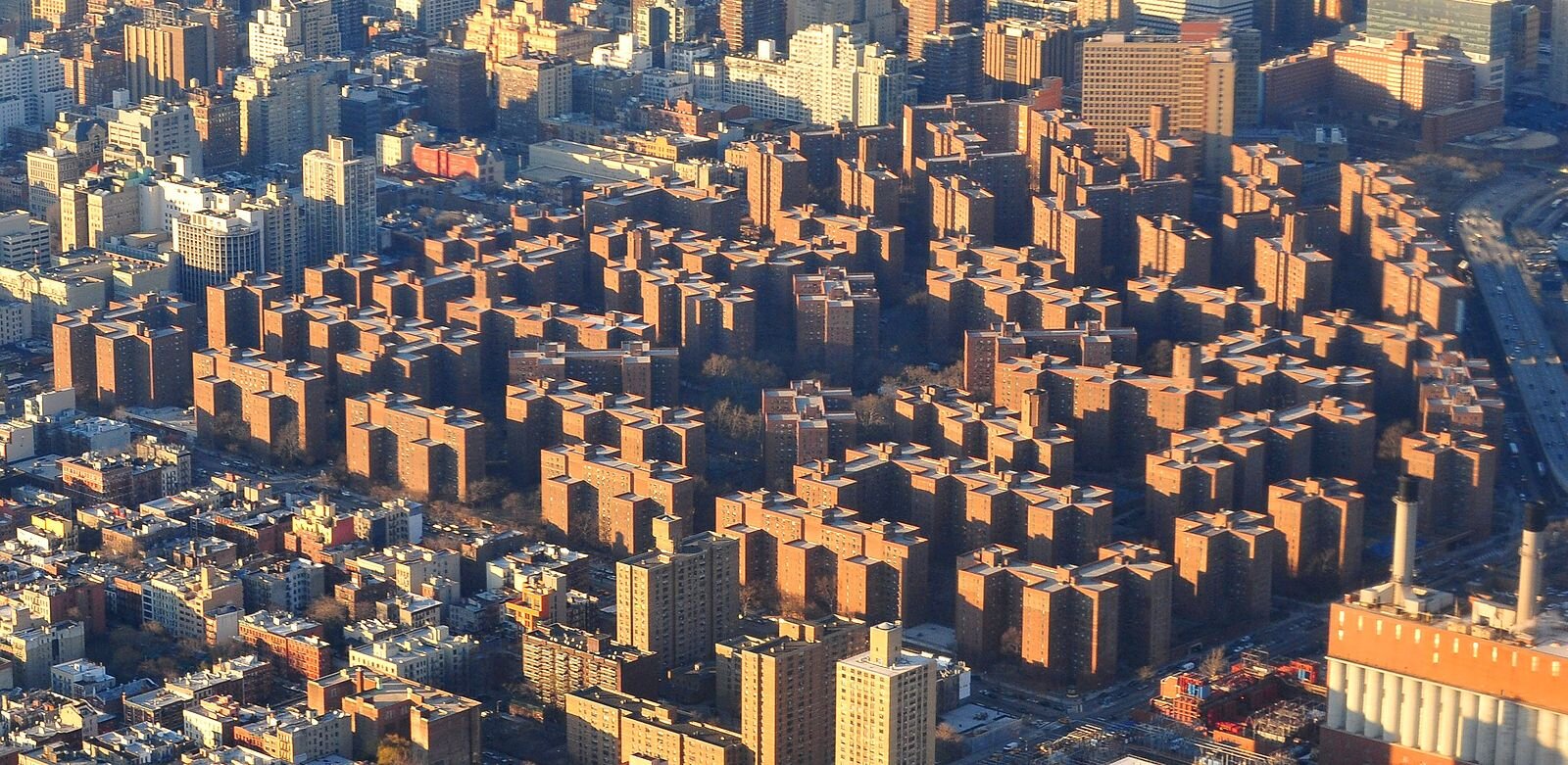
Stuyvesant Town (bottom and left) and Peter Cooper Village (top and right)
However this new, better quality of life wasn’t intended for all. According to Metropolitan Life’s president Frederick H. Ecker, African-Americans would not be permitted to live on the development; he told The New York Post, “If we brought them into this development, it would be to the detriment of the city, too, because it would depress all the surrounding property.” Prices were also set so high that only 3% of the former Gas House District tenants (which comprised a high number of African-Americans) would have been able to afford the rent, therefore adding another layer of discrimination. From the moment that tenants began moving in in 1947, the segregation ruling caused major conflict, with a group of tenants forming a committee led by resident Dr Lee Lorch, who together fought against the ruling with petitions, pickets and a failed legal challenge in 1949. It wasn’t until 1951, after years of protest and the death of Metropolitan Life’s president, that segregation was finally overruled and black families were permitted to move into the area. The battle and eventual success inspired an open-housing movement that led to housing discrimination being made illegal nationwide, becoming a landmark in de-segregation and racism in the USA.
As an African-American Beverly Loraine Greene herself would not have been permitted to live on the development in its early years, yet she broke barriers by not only being the first black or female architect to be hired for the project back in 1945, but being the first architect full stop hired for the project. That said, shortly after taking up the position, Greene won a scholarship to study urban planning from Columbia University and quickly left the project in order to return to education full-time, graduating with a Master of Arts in architecture. Upon graduation from Columbia, Greene then went on to work for Isadore Rosenfield on the design of healthcare facilities (including Unity Funeral Home in New York where Greene’s own memorial service would later be held), a role she stayed in until 1955. She also took on projects with Edward Durell Stone during this period, including the arts complex at Sarah Lawrence College and a theatre facility at the University of Arkansas. Furthermore, Greene also worked with the architectural firm headed by Marcel Breuer on the UNESCO United Nations headquarters in Paris, France (pictured below) as well as various buildings for New York University.
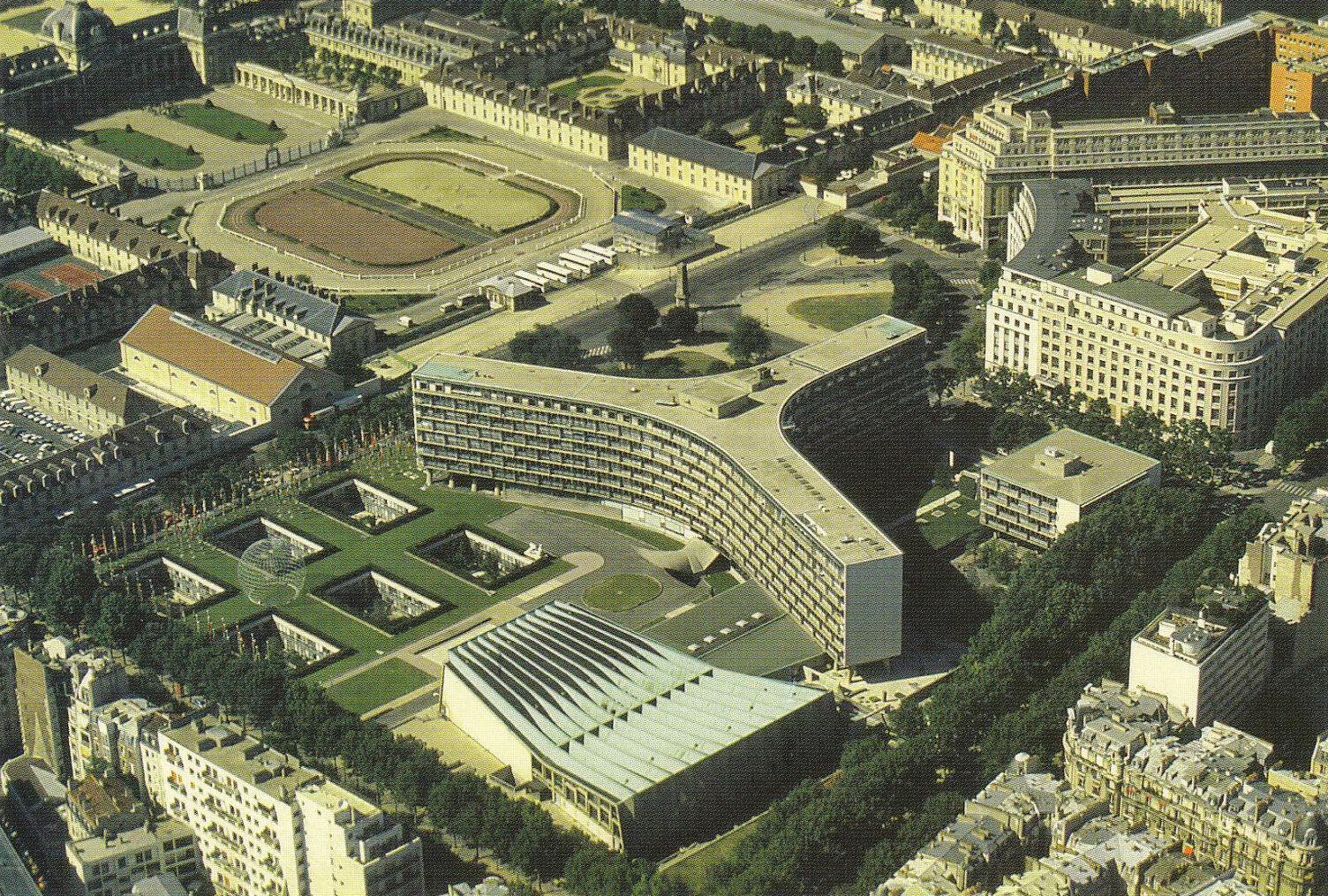
UNESCO Headquarters, Paris. Architect: Marcel Breuer, completed 1958
Sadly, Greene passed away aged just 41 on 22 August 1957, prior to the completion of UNESCO in 1958, as well as a number of the NYU buildings she had worked on, which were completed between 1956 and 1961. Her career was undoubtedly cut short; we cannot help but wonder what Greene might have gone on to achieve given the numerous barriers she had already broken as an African-American woman. Her legacy cannot be understated.