The Master of The View Master - Charles 'Chuck' Harrison
Whilst the circumstances surrounding the ‘Black Lives Matter’ movement are far from positive it is perhaps important to attempt to draw positives from it and a good way is for white people, like me, to educate themselves more on the contributions that black people have made to the things we hold dear.
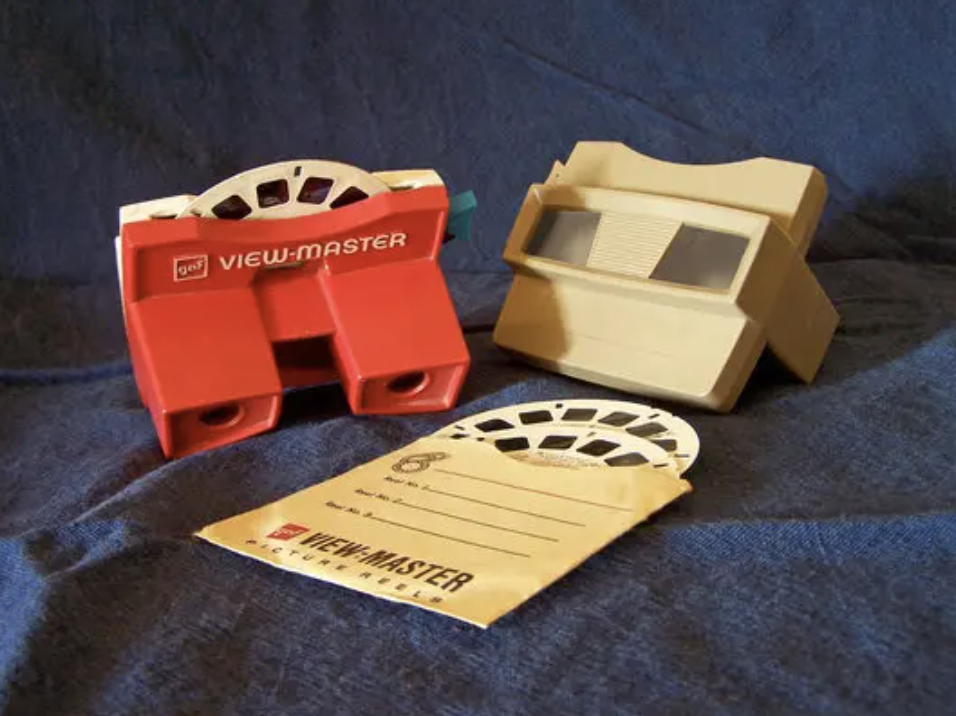
So we were delighted to discover recently that something we hold dear ‘The ViewMaster’ was designed by an African American - Charles ‘Chuck’ Harrison.
Born in 1931, his father was a teacher of Industrial Arts at Southern University and later a Professor at Prairie View A&M University in Texas - an historically black university. After studying a Bachelor of Fine Arts at the Art Institute of Chicago from 1949 to 1954, he was drafted into the US Army where was in the topography unit.
Initial attempts to secure work were hampered by his race so he worked on a freelance basis - with clients willing to accept his work but not willing to employ him. After impressing the Sears company with his designs he was finally given a position on the design team but not before he had redesigned the ViewMaster in 1958 , whilst working for Robert Podall Associates.
MOMA regards the View Master as a design classic and their description is thus :
“A mass consumer device marketed as a toy, the original View-Master came with thin cardboard disks, or reels, containing stereoscopic pairs of small Kodachrome photographs that when viewed through the apparatus created the illusion of three-dimensional scenes. Invented, manufactured, and sold by Sawyer’s Photo Services in the United States (a company specializing in scenic postcards, slides, and slide projectors), the contraption debuted at the 1939 World’s Fair in New York.
In 1958 a young designer by the name of Charles “Chuck” Harrison redesigned the View-Master at the Chicago firm Robert Podall Associates. His Model F reduced the bulk of the batteries in earlier View-Masters. His Model G, produced from 1959 onward, abandoned the original Bakelite for injection-molded plastic, which allowed for a range of colors and designs that revolutionized the product’s market appeal. Reels depicting the 1964 World’s Fair in New York, the lights of the Las Vegas Strip, and even scenes from outer space further cemented the View-Master’s place in popular culture.
In 1961 Harrison joined the staff of the department-store chain Sears, Roebuck and Company, where he would remain for thirty-three years. He was the first black executive at the company’s headquarters and one of very few prominent professional designers of color at that time. Aside from the View-Master, Harrison’s products included lawn mowers and power tools, pots and stoves, and the very first plastic trash can.”
Whilst his design for the ViewMaster has endured in popular culture it his perhaps his design of a plastic trash can that his work has probably impacted most on society. Trash cans traditionally had been made of galvanised steel and the sound of bins being knocked over and emptied was part of the urban experience. Harrison took advantage of the improvement in plastics, changed the traditional shape of round to rectangular and added wheels making then lighter, easier to use and cheaper. “No more clang-clang of metal before breakfast.” said Harrison of his proudest achievement.
Harrison designed hundreds of consumer products for Sears over the course of his career. When the Cooper Hewitt design museum in New York gave him its National Design Award for lifetime achievement in 2008 the citation read that he “improved the quality of life of millions of Americans through the extraordinary breadth and innovation of his product designs,”
Charles ‘Chuck’ Harrison died aged 87 in 2018